Sunday, 9 October 2011

#71 The immoralist

171 pages.

So this is the last book I read for the Yellowstone summer, a short, almost novelette, book.  This is only the second book I have read by Andre Gide, and this is slightly better that Straight is the Gate.  Having said that, I found the book slightly scintillating and mostly boring.  The main character was strange and acted sometimes in a way I would act, but at other times his behavior was foreign to me, so relating to the protagonist was difficult.  And to be honest I found the narrator/protagonist annoying.  One thing I will say is that the translation was very good, and this may owe something to Gide's way of writing fluid sentences.  Not once did a sentence feel out of place, or was any word jarring.  Other than that I look at this book as some fluff at the end of the season.

Friday, 7 October 2011

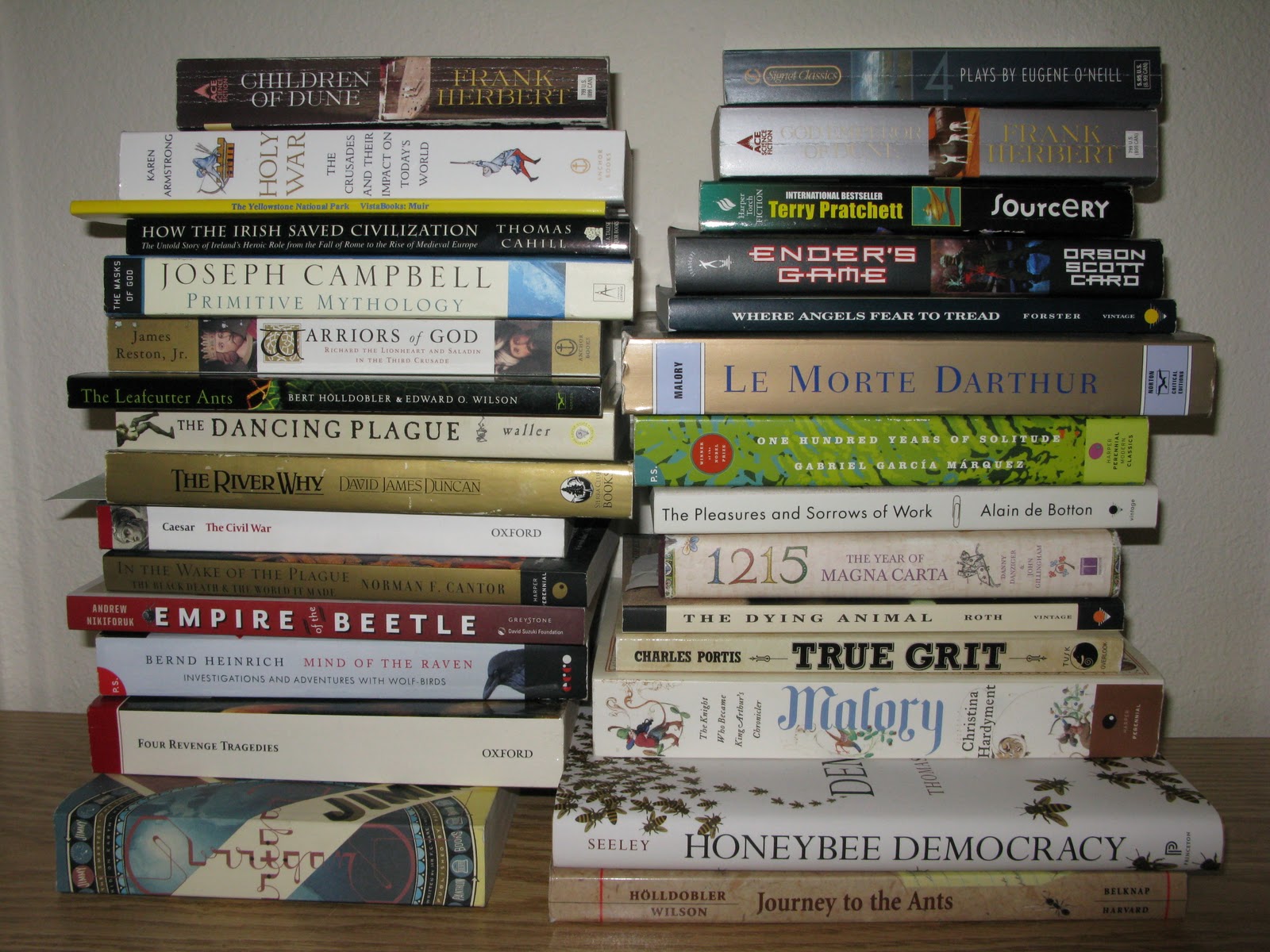
Books read at Yellowstone - 2011

So here are the books I read this summer.  April 28-October 10 2011.  Not pictured: Chaucer and Shakespeare.  The majority of the books were read on the job, actually probably around 85% were read on the the job.  It would appear that I was intellectually lazy off the clock.  I didn't read nearly as many as I wanted to, but this is definitely more than I managed to read in the last two years.

I'm hoping the three months in the winter are more productive.  I plan on reading more Renaissance plays and I'm going to get to Faulkner, which I never got around to this summer to my regret.  Also, I plan on reading at least one Oregon writer a month in the winter: Kesey, Paluhniak, Le Guinn, and maybe Raymond Carver.

#70 The River Why

310 pages, by David James Duncan

I've read about 40 or so books this summer and I can easily say that this one is in the top 3, but undecided among them.  The other two contenders this summer are Mind of a Raven and Holy Wars.

What makes this book so good is the humor, which was quite good at times, and the amazing prose of Duncan.  Few wcontemporary writers can compare to the ease of his writing, and so fluid.  The themes in this novel are easily understood and appreciated.  The character of Gus Orviston is easy to sympathize with, and makes for a rather funny narrator.

And another reason this is an amazing book is the author is one of those rare breeds, an Oregonian.  The novel is set in Oregon, and many of the place names are real, and the made up Tamanawis River feels real.  Maybe I liked this because it was set in Oregon, and not too far from where I lived and the characters that people the book seem very Oregonian.

Maybe I should do the Oregonian challenge and read 5 books a year by an Oregonian native or transplant.  At least this way I will have an excuse to move One Flew Over the Cuckoo's Nest to the top of my list.

#69 The Dancing Plague

231 pages.

A strange case of a plague (mental) disturbing Strasbourg in 1518.  This was an easy read and fun too, if strange suffering and compelling dance can be fun.

Life sucked for the peasants in 1518.  They were being oppressed on all sides and the only comfort they could have was through the occasional revel.  And then St. Vitus, the dancing saint, was introduced to Strasbourg.  And his saint-cult was the suggestion that started the dancing plague, which was an uncontrollable urge to dance until either the person died, and hundreds died, or the person eventually recovered.

Disgusting details:  The dancers would dance until their feet were bloody and then would continue to dance.  Many dancers, because they could not stop, relieved themselves while dancing.  So they were covered in urine and feces and kept going.  Apparently many of the dancers would scream out in agony as they danced, and yet could not stop.  Others would tear leg muscles and still keep dancing.  This is a terrible affliction, and the writer concludes that it was a mental condition created through extreme stress and unhappiness.

I enjoyed reading about something I had no idea even existed.

#68 The Atheist's Tragedy

This is the final play in my short anthology of Renaissance Revenge Tragedies, and it wasn't the best, nor was it the worst.  The play was written by Cyril Tourneur, whom I have not heard of before reading this play.  I was hoping for a gruesome revenge play where death was everywhere reaping various criminals, but I was sorely displeased.  There was some death, and the most notable is of course to the atheist who does himself in by striking an axe into his own skull.  And with this axe in his skull he confesses all of his crimes as his brains oozed out, at least I imagined the brains oozing out.  The lack of detail allowed my mind to embellish the death.

Other than that this play seemed more of a play about lust than revenge/greed, and the lust in the play seemed out of place.  Like it wasn't part of the original idea but thrown in to complicate matters and bring about some death.  For a revenge play, or even any play this one did not fit the normal structure of straight revenge but had digressions and other themes going on.  The play's structure seemed original to me, but that may mean the writer was disorganized, because the originality did not make the play an better, just more surprising.

Wednesday, 5 October 2011

#67 Jimmy Corrigan: The World's Smartest Kid

380 pages, by Chris Ware

I have no idea what to make of this extremely complex graphic novel.  It has elements of postmodernism, stream of consciousness, and sometimes just unexplainable events.  At first I had a troubling time reading this book, but after a couple of hours I began to get the hang of it.

There were moments of pure humor, and other times (most of the time) the book was depressing.  The main protagonist is Jimmy Corrigan, a 37 year old who has no friends, no prospects for romance, overweight, homely, and is socially uncomfortable.  I hesitate to even refer to him as a protagonist as the story happens to him while he remains passive to the world around him.  Another parallel story is of his grandfather who suffered under a terrible father.  If there was one main theme in the book it would be issues concerning fathers, as the two fathers were both negligent and for the most part missing.  The story is about an awkward reconnection with a missing father that ends in the father's death through an automobile accident on Thanksgiving.  But from what I understand this book is partly autobiographical.

Monday, 26 September 2011

#66 John Muir: The YNP

This is the first time I have read John Muir, and this is a short book, or a long essay on Yellowstone National Park.  Though the book is a short one, 64 pages, there is much in here that makes it an object of interest to any Yellowstone denizen, such as myself.  Written in 1901, much has changed in the park and much is still the same, and it is these differences which really makes this a worthwhile read.

This short book is thematically divided into three parts, even if the editors kept it as one long whole.  The first part is written as a prosaic idyll in the style of Theokritos, or one of the more picturesque of Virgil's Eclogues.  He wastes no time with his material, and begins his description starting with his second sentence, "[Yellowstone] is a big, wholesome wilderness on the broad summit of the Rocky Mountains, favored with abundance of rain and snow, -a place of fountains where the greatest of the American rivers take their rise" (3).  Now imagine reading sentences of similar tone for a further 20 pages, and that is the first part of the book.  Occasionally he will include a bit of tension by invoking enemies of his eden, "In pleasing contrast to  the noisy, ever changing management, or mismanagement, of blundering, plundering, money-making vote-sellers who receive their places from boss politicians as purchased goods, the soldiers do their duty so quietly that the traveler is scarce aware of their presence" (9).  Themes like this appear randomly in the book, and it seems that Muir was sensitive to any threat to what he felt should be wilderness.  At times he laments the destruction in adjacent areas (9) and sometimes the ignorant tourist.

The second part of the book focuses more on the geologic and thermal features the park has to offer.  This is more of a catalogue that describes wonders and beauty with a limited language that can only approximate the beauty.  There is one part of this section that I did find of peculiar interest, and that was questions that tourists asked in 1901.  "Where is the umbrella? What is the name of that blue flower over there? Are you sure the little bag is aboard?  Is that hollow yonder a crater?  How is your throat this morning?  How high did you say the geysers spout?  How does the elevation affect your head?" (30).  These are a nice collection of questions, some of which I've heard and others, not so much.  I mainly hear, where is a good place to see animals?  What time does the sunrise?  Do you have air conditioning, wifi, complimentary coffee, and where can I park?

At one point there is a digression on rattlesnakes and 'civilized' man's fear and hatred of them.  Muir makes a plaintive and pitiful plea to do no harm to these creatures.  He cites a common question often directed at the most noisome of pests, "What are rattlesnakes good for?" (37).  His rejoinder is, "As if nothing that does not obviously make for the benefit of man had any right to exist" (37).  His case is lacking in any scientific points, but strictly moral.  Had the question been asked today to a knowledgeable person the answer would involve the Greater Yellowstone ecosystem and the rattlesnakes small part to play.  I am unsure of the snakes role on the ecosystem, but removing it could have unforeseen results.

The third part of the book is more of a written tour guide as well as offering some historical anecdotes of the area.  This book, though never explicitly stated, is a voice for the wilderness trying desperately to make a case for preservation and enjoyment.  The reserve of this land for the people is an argument that has to be continually made, and Muir is doing his best to appeal to the pastoral side of his readers by invoking a place of simple soulful beauty.